Selling at the market table: what research on vendors and makers has found
Farmers' market surveys, a sociologist's critique and a platform's seller census each describe part of in-person selling. None describes all of it.
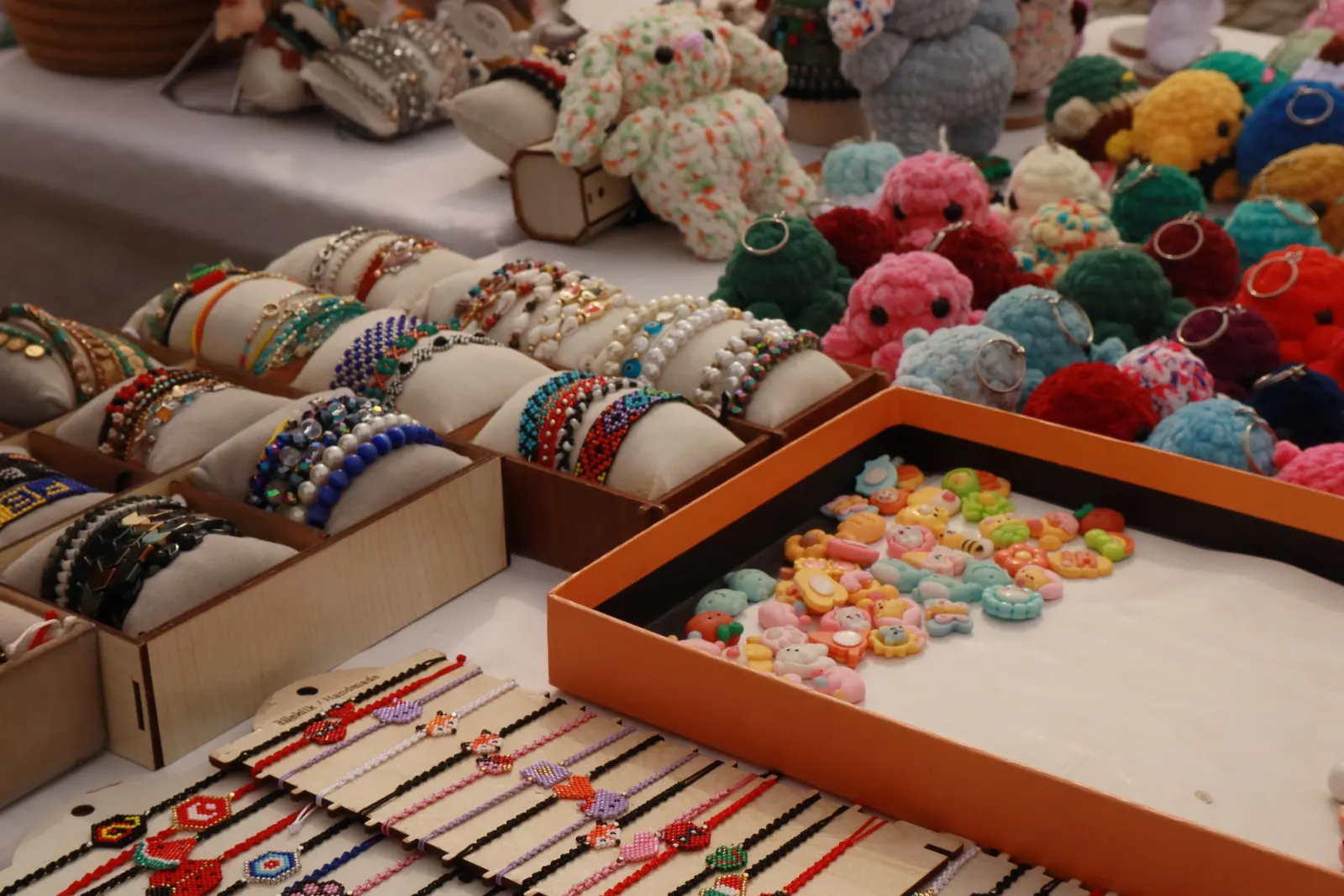
Weekend markets, holiday craft fairs and roadside tables are among the oldest ways to sell something made by hand. They are also among the least measured. The research that exists comes from a handful of academic studies of farmers' markets and from surveys run by the companies that sell handmade goods online. Each source sees part of the picture.
Markets as places to learn
In 1999, a team made up of Gail Feenstra, Christopher Lewis, C. Clare Hinrichs, Gilbert Gillespie and Duncan Hilchey mailed surveys to vendors at 20 farmers' markets in each of three states: California, Iowa and New York. Their 2003 paper in the American Journal of Alternative Agriculture sorted vendors by enterprise size. Small enterprises made up roughly 56 percent of vendors, and more than half of those were run by part-time farmers or market gardeners.
The small vendors reported fewer entrepreneurial activities at the market, fewer business contacts and fewer new skills than larger ones. Yet they were the group most likely to describe the farmers' market as their most important opportunity for business development. The authors suggested that the financial gains for these vendors may be modest, while the market remains one of the few places where they can hold a niche in the local economy.
The study has clear limits. It covered three states, relied on vendors' own descriptions, and was collected a quarter century ago, before online selling changed how small producers find customers. The published abstract does not give a final response count, which makes it harder to judge how representative the respondents were.
Face to face, but still a market
Hinrichs, writing alone in the Journal of Rural Studies in 2000, questioned a common assumption about direct sales: that meeting the producer automatically creates trust and community. Comparing farmers' markets with community supported agriculture, she argued that farmers' markets do bring sellers and buyers closer but remain "fundamentally rooted in commodity relations." Price and self-interest do not disappear because a sale happens across a folding table. She also suggested that the advantages of these arrangements may rest more with educated, middle-class shoppers than with producers or lower-income buyers.
The paper is largely conceptual, so it offers a framework rather than a measurement. It remains widely cited because it separates the social appeal of in-person selling from its economics.
What platform surveys show
For makers of goods other than food, the largest data sets come from companies. Etsy's 2017 US Seller Census was based on an online survey developed with the research firm GfK and conducted between November and December 2016. It reported that 87 percent of US respondents identified as women, 77 percent ran businesses of one, and 97 percent operated from home. Fifty-eight percent said they also sold or promoted their goods elsewhere, including craft fairs, flea markets, trade shows and retail stores, and 32 percent described their creative business as their sole occupation.
These figures need careful handling. The research and writing were done by the platform itself, invitations went by email to sellers with at least one sale in the prior year, and the report does not publish a response rate. Sellers who answer such surveys may differ from those who do not, and a company has its own reasons for presenting its sellers in a favorable light.
The wider economy around crafts
Doreen Jakob, in the Cambridge Journal of Regions, Economy and Society, examined the growth of craft businesses during the global downturn that began in 2008. She argued that the main economic drivers of the so-called third wave of crafting were not the crafters themselves but craft support companies, and that the business strategies of those companies often sit uneasily with the ideals that draw many makers to handwork.
Read together, these sources describe a sector that is easy to see at the market table and thinly documented in public statistics. Most of what is known comes from small regional samples, conceptual work and company surveys, and each carries its own blind spots.
Sources
- Feenstra, G. W., Lewis, C. C., Hinrichs, C. C., Gillespie, G. W., Jr., & Hilchey, D. (2003). Entrepreneurial outcomes and enterprise size in US retail farmers' markets. American Journal of Alternative Agriculture, 18(1), 46–55. https://doi.org/10.1079/AJAA2003046
- Hinrichs, C. C. (2000). Embeddedness and local food systems: Notes on two types of direct agricultural market. Journal of Rural Studies, 16(3), 295–303. https://doi.org/10.1016/S0743-0167(99)00063-7
- Etsy. (2017). Crafting the future of work: The big impact of microbusinesses (2017 Seller Census Report). https://extfiles.etsy.com/advocacy/Etsy_US_2017_SellerCensus.pdf
- Jakob, D. (2013). Crafting your way out of the recession? New craft entrepreneurs and the global economic downturn. Cambridge Journal of Regions, Economy and Society, 6(1), 127–140. https://doi.org/10.1093/cjres/rss022
This article is general educational content published by Porch Works. It is not professional advice and does not describe or assume anything about any individual reader. See the disclaimer.